00:00:01
So this audio that I’m recording… it’s in relation to this wonderful documentary that I’ve just seen: Donna Haraway’s Storytelling for Earthly Survival. Um, well, I wrote down some ideas about this documentary. It’s basically her own thoughts and reflections, in dialogue with the interviewee of the documentary, relating to this idea of kinship. I was really touched because, in other words, I guess it’s what sometimes I’ve been naming. Naming, like, how to coexist and live with others, understanding the other as something that’s, uh, sometimes a canceled or not an accepted part within ourselves, but also how these different communities outside of what we already recognize as familiar exist.
00:01:18
So this can be an ‘other human.’ Other species, and other space, and other ecosystem. So what Haraway basically mentions in this documentary (there are too many ideas), are two that have impacted me now. On the one hand, how she proposes the best way of thinking, in our context right now, is through the practice of storytelling. And there’s something that I found really interesting when she mentions how the stories that we are most used to telling, that we are most accustomed to, are these stories surrounding killing, surrounding second births, surrounding the design or the presence of (primary) weapons. So in some way, they are stories that are not thinking about life. They are thinking about death, and death not in a transformative way.
00:02:26
And with transformative, I don’t necessarily mean optimistic, but this essential quality of Gaia, that intervenes in life and subsists and survives and is resilient, like the fungus. So she proposes that we kind of think of different ways of storytelling as a recovery of this lively part, these stories that are mostly based on the (quite obvious and not) life side of life. So, for example, she opens this gateway through these ideas into criticizing what has been going on with the history of philosophy as a discipline, and that we’ve been receiving this male perspective on philosophy, which is actually more of an attitude rather than just a discipline. So, from this history of philosophy, what we inherit…
00:03:25
…is this idea that the ‘second birth’ is something that happens after we die, and that this second birthing is actually what brings us into our most, let’s say, crystallized way of being. So she criticizes this because, for her, birthing is birthing. The first birth, as the male historians and philosophers would usually say, is actually a feminine verse. Because it’s like these motherly cycles of birth in nature, of forming life out of the compost, for example. Which is kind of like the death of certain life matters, but at the same time, it’s the nurturing of new life. So, it’s like thinking about the feminine fertile in the broader sense, and so on. So, it’s not thinking about the afterlife, but thinking about life now and in its different cycles.
00:04:24
So she thinks that when you sort of translate or transpose this idea onto words—the livelihood of thinking, which is what I believe, I think this is how she thinks of philosophy—then she mentions that this change of storytelling is important because this allows us to, um, care for a constant need of being a rebel, of insurrection, of revolution. In the matter that we would be refusing the paralysis of critique, uh, which is, um, like a place where we are in this stuck idea that the world is finished because we know how it works. But the world is not finished. The world is in constant holding and shaping, especially with uncertainties.
00:05:23
So, in that context comes the second thought that I really loved, and it’s about maybe a more horizontal way of dealing with what we’ve defined and felt and constructed around the concept of ‘relationships.’ And thinking on how the world relates, and its origins; its origins are brought from a logical point of view. When actually, relationships… it’s actually referring not only to the biological connections but also to these exchanges, these intimate intertwinings, that we have with people that are not necessarily a biological family. And that are not necessarily human, like for example, how she shares with us, through this documentary, her kinship with her dog, Cayenne. Uh, so in that sense, it’s really interesting because I want to keep thinking on how this connects with Lynn Margulis’s or Janine Benyus’s proposals, which are also women. Because what she’s trying to propose, through the idea of kinship…
00:06:32
…in dialogue and in contrast to relationship, is kinship. This, uh, possibility of building homes, building, um, spaces where there are reproductive systems beyond the biological. That spark through, let’s say, some sort of very deep affinities that we subtly share with others. Again, other humans, and again, other non-humans. And I love this idea because when I think of my affective relationships, and when I think, “Where do I come from? My difficult contexts, what has healed me?” I can think of human people. Mostly non-biological relationships. But I especially go to these kinships that I’ve had with non-human entities, especially my cats, especially my dogs, especially some of the spaces that I’ve visited. Uh, like for example, this contemplation of the sea. There’s one difference, to me at least, on being in front of the sea and just contemplating it…
00:07:51
…and there is another thing: to have the feeling that you have some sort of bond with the sea. So, putting that in the lens of Haraway’s proposal, I think it’s quite possible to speak about kinships with places, spaces, with nature, with non-human, with human. It’s interesting because when you think about the non-human, you also have to include the microscopic life that is in you, and the microbiotic as well. So, there is some sort of kinship: kinship in health, kinship in sickness or in illness. Maybe even try to approach it with different storytelling again, like Gabor Maté proposes in his book on relational health, for example. What perspectives do we have? Like a lens through which we see trauma, with, how do we…
00:08:43
…see illness and health? And maybe a step back would be thinking about these connections as kinships. But, well… In the case of Haraway, she’s more focused on life itself and, I guess, some sort of giving us tangible evidence of what happens outside, so we can understand what happens inside. Not only in the microbiological way of, uh, imagining that, but also in how our ideas, our thinking, our imagination intertwines itself to produce, to reproduce something different. So in that matter, this video, this documentary, I have some other ideas here around the importance of thinking also about the intimacy of inheritance, and where it is located, like in which big things or little things. And I think in this place, the concept of ‘realia’ shows up.
00:09:47
Because, as she mentions at the beginning of her documentary, it’s like the basket that she keeps at her home from this Native American community. Or, for example, the barking of her dog when she’s woken up and she’s confused because her dog is elder. So, what? Things from your daily basis are actually realia that evidence the intimacy of these kinships. Kinships that are built by present kin, but also the evidence of kinship out of this inherited stuff. So, what I found really touching when she was speaking about her dog was also how she reconfigures her sense of responsibility in the means that it’s basically a company. Accompanying the other with the consciousness of their differences, like for example when she mentions that her dog is old, but she is not as old as her dog.
00:10:45
So she is in the responsibility of accompanying her in those brief moments of disorientation due to an elder age. I find this really beautiful: how, besides proposing kinship and, behind that, storytelling, also thinking in those skin shapes that might not fit the description, like, might not fit the box. The different boxes that have been ready-made for us to just fill them in. What happens if we are out of the box? What happens if we are in the interstice of language? What happens if we are in the in-between of two categories, of two boxes? What happens then? And that’s where she proposes the odd-kin. And there’s this beautiful image, actually a short story that she tells at the end of the documentary, where she mentions about this girl, Camille…
00:11:44
And she mentions about the symbionts, which are like, uh, vital presences that you choose as some sort of companionship during your whole life. And this means that you can choose, for example, a human or a non-human. And in the story, she mentions how Camille chooses a non-human. And her non-human is a butterfly (I’m sorry—the butterfly? Or was it a moth? I can’t remember well, but at the end of the story, or the story in progress, she mentions how she wanted her face to be intervened). So, by accepting her identity and her body’s embodied performance or embodied being as female, she wanted a beard. However, she wanted that beard to be made out of the antennae of butterflies. So she does that. She decides to intervene in her female body like that.
00:12:42
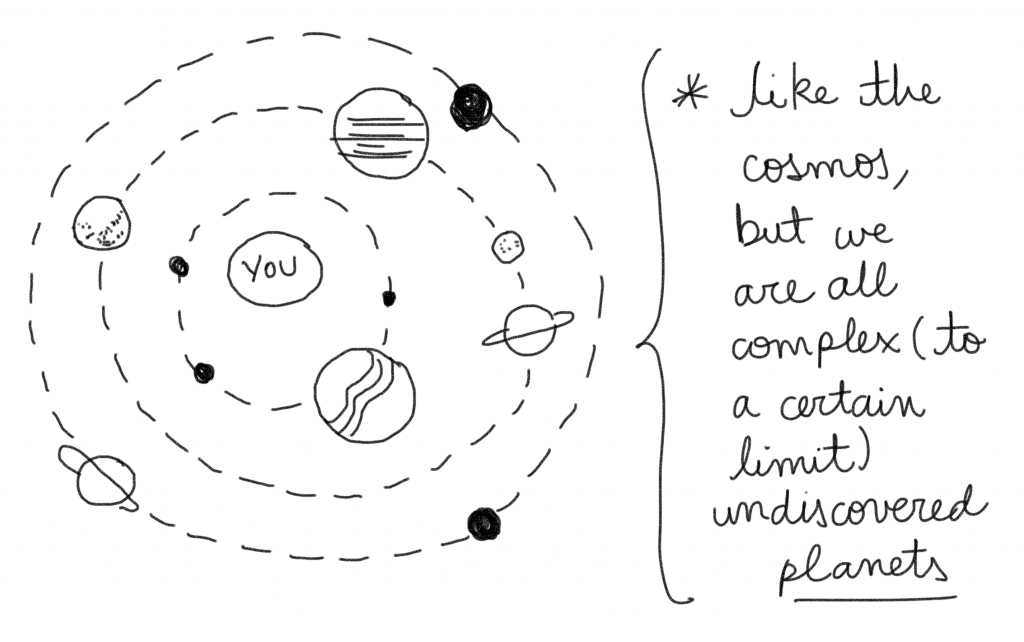
So it’s interesting because then, herself (um, let’s say, in most parts, easy to recognize as a female presence, identity, or body) with the beard, kind of puts you in the spotlight of “What do you think that being is? What do you think Camille is?” And that’s where odd-kin show up. What parts of my symbionts do I pick as an important part for me to feel like I am in my essence, in my presence, in my identity? So, in a crazy way, I think… I don’t know. When I think of that as some sort of metaphor for what happens to me, to people in our daily basis, we are actually kind of like an affective Frankenstein. We are therefore a Frankenstein that speaks its own tongue.
00:13:42
Understanding the tongue, the language, as not only the oral one, the verbal one, but how do we communicate, how do we interact with each other? Which are our gestures? And which are our ways of healing, sharing something with someone else as part of this storytelling practice? Because at the end of the day, storytelling is communicating, expressing in more than just a rational or an effective way; it’s actually more of an affective one. And an intermodal one. So when that’s in action, a kinship can be activated because, again, we are like this Frankenstein. And that’s, I guess, how this proposal of Haraway comes a step further from what she once wrote in A Cyborg Manifesto, in which she questions these binary ways of seeing the world, these dualities at times.
00:14:37
And at the end of the day, they’re always in between, again, interstices where love is born, and life exists, and life coexists, and life keeps reproducing itself instead of just surviving. So I guess that’s for now. Lots to think about. I think it’s really touching because, then, trying to situate this as a new learning out of my master’s program in interculturality or intercultural practices, it allows me to think not only in a human-centered, self-centered point of view of how can I empathetically or sensorially or embodiedly connect with an other, but to actually go to a much more complex part of this. And recognizing that I stopped being just human nowadays. That we are in kinships where we are constantly modifying ourselves.
00:15:41
But unfortunately, maybe on a line of ‘like’ death and killing storytelling, instead of seeing that as maybe a more reproductive way. You know, thinking about the word reproduction: it’s about producing again, and that takes me back to the collective and community work. Because only in those places of kinships, only in those places of intimate relationships and exchanges, do we see how being tolerant of an other, how being accepting of the difference that the other brings and that the other that inhabits us in the idea of this Frankenstein, that’s the only space where something can be produced again. Because I produce it, I exchange it, the other one goes on with that, and so on and so on and so on. Like the domino effect, but even maybe more than that: like the echo when the stone touches the sea, and then an external stimulus affects a specific environment, and the specific environment reacts back, and then starts intertwining an effect and an affect of things.
00:16:52
So interculturality can also, and maybe what’s more needed now, and this also connects Haraway with Janine Benyus, maybe it’s thinking about interculturality in relation to those. To trying to ask ourselves: where do our kinships reside? And from those kinships, what are the Oddkin? Uh, how can I see them? What realia evidences them or manifests them? What parts of me are realia, perhaps, that evidence the inhabitants of an other human or non-human within myself? And how do I inhabit others as well? And how do we relate? So interesting to go beyond the biological that is our point of origin, but to see our process: a process of re-producing, of producing again and again and again, and transforming ourselves and the others and our context, is maybe through another type of relationship. Even thinking not about how do we connect, but why we connect. And that’s the point of kin. That’s the kin of kins.